Street Trees
The City of Redlands has approximately 56,500 tree sites located within the City’s right-of-way and City owned properties. Of those sites, approximately 42,700 are home to trees that live within the easement area abutting City streets and have been coined the term “street trees.” The City holds its urban forest in high regard and in partnership with the Redlands Street Tree Committee is dedicated to the continued enhancement, maintenance, education and care of this living asset.
Street Tree Palette
Street Tree Policy & Protection Guidelines Manual
Proper Tree Planting Guidelines
Street Tree Encroachment Permit
Permit to Trim, Plant or Remove Public Trees
A Public Tree Encroachment Permit is required for an trimming, planting, or removal of any tree in a City easement.
This permit allows residents to hire approved contractors to trim, plant and remove public trees
The City waives the permit fees associated with the voluntary trimming, planting or removal of public trees by residents who hire certified contractors, subject to the approval of the Facilities & Community Services Department.
Submit the completed permit application via email or in person:
Facilities & Community Services Department
35 Cajon Street, Suite 222
Redlands, CA 92373

Tree City USA
As a result of the City’s dedication to sustaining a healthy and viable urban forest the City has been named a Tree City USA city by the National Arbor Day Association for 24 years.
Tree Watering Guidelines
Our city is comprised of a few different types & mixtures of soils across our 36 sq miles. The following is a list of general guidelines for use when watering trees, especially during months without rainfall.
- The average tree requires approximately 160 gallons of water per month. This can be applied by running a soaker hose with a low flow of water for 15 to 20 minutes (equivalent to four 5 gallon buckets), two times per week.
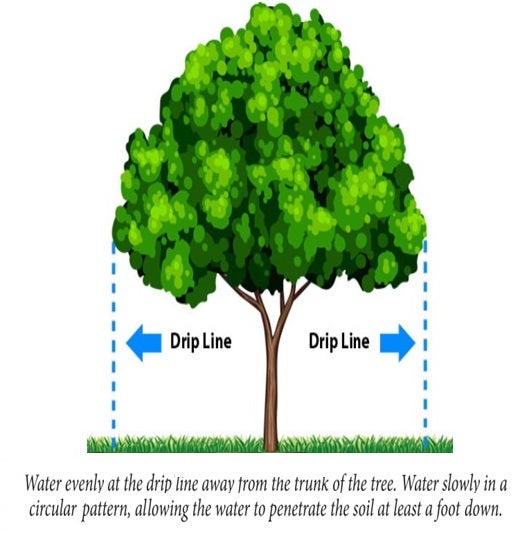
- Watering should be applied at the dripline of the tree (outer perimeter of the tree foliage).
- Watering of trees is exempt from irrigation restrictions provided no water waste occurs. Spread mulch as far out as the branches reach (if possible), approximately three inches deep. Do not pile mulch against the tree trunk as this may rot the bark and trunk.
- Don’t dig holes in the ground surrounding the tree in an attempt to deep water as it will only dry out the feeder root system.
- Never assume that any tree can go without water, even “drought tolerant” species. We encourage the use of an in-ground irrigation system when possible.
Fun fact: Providing adequate water (160 gallons) per month will cost a property owner roughly $1.45, per billing cycle, at current rates.