Accessory Dwelling Units
The City uses current State law for the construction of ADUs.
General Requirements
The following list is provided as an overview of the general requirements in State ADU law, but may not list all applicable regulations for your particular project.
Please read and review the Accessory Dwelling Unit Handbook provided by HCD – see link to PDF document at right.
Number of ADUs per lot:
Single-Family Residential Lots:
- One (1) detached, attached, or existing space conversion;
- One (1) Junior ADU within an existing or proposed single-family dwelling; and,
- ADU per Gov. Code Section 66323.
- The space must have exterior access from the existing or proposed single-family dwelling.
- The side and rear setbacks must be sufficient for life safety.
Multi-Family Residential Lots:
- On a lot with a proposed multifamily dwelling: up to two (2) detached ADUs.
- On a lot with an existing multifamily dwelling: up to eight (8) detached ADUs. However, the number of ADUs shall not exceed the number of existing units on the lot.
- At least one (1) ADU within an existing multifamily dwelling, up to 25% of the existing number of multifamily units (Gov. Code Section 66323 units). All interior ADUs, however, must be converted from non-livable space such as storage rooms, boiler rooms, passageways, attics, basements, or garages.
- A Junior ADU cannot be constructed on a multifamily site concurrently with an ADU.
- A lot where there are currently multiple detached single-family dwellings is eligible for creation of one ADU per lot by converting space within the proposed or existing space of a single-family dwelling or existing structure, and by building a new detached ADU.
Maximum ADU Size
Detached ADU: Maximum 1,200 square-feet of interior living space.
Attached ADU: Maximum of 50% of the floor area of the existing primary dwelling, and at least 800 square-feet minimum.
- ADUs are allowed to add up to 150 square feet beyond the physical dimensions of the existing accessory structure to provide for ingress/egress.
Junior ADU: Maximum 500 square-feet of interior living space.
- Junior ADU is required to be created within the existing walls of the single-family residence (or attached garage).
- Junior ADU is not allowed to add up to 150 square-feet beyond the physical dimensions of the existing primary unit or structure.
Setbacks for ADUs:
Front yard: 25 feet minimum in most single-family residential districts (R-1, R-E, R-S, R-A, R-A-A, R-R, R-R-A, A-1 and A-2) and specific plans (note: exceptions may apply to Gov. Code Section 66323 units – refer to HCD Handbook). To verify the required yards and setbacks for residential Specific Plan areas, please refer to the Specific Plans webpage (click here). Front setbacks may vary for corner lots, key lots, reverse corner lots, etc. (please refer to the zoning district standards listed in RMC Title 18 – Zoning Regulations).
Side yard: 4 feet minimum & maximum (applicant may choose to provide a larger setback)
Rear yard: 4 feet minimum & maximum (applicant may choose to provide a larger setback)
Converting an existing structure to ADU:
- A local agency may allow the expansion of a detached structure being converted into an ADU when the existing structure does not have four-foot rear and side setbacks.
- A local agency may allow the expansion area of a detached structure being converted into an ADU to have no setbacks, or setbacks of less than four feet, if the existing structure has no setbacks or has setbacks of less than four feet.
- A local agency shall not require setbacks of more than four feet for the expanded area of a detached structure being converted into an ADU.
Permitted projections into yards (see RMC 18.152.070):
- Open, unenclosed, covered patios may project to within five feet (5′) of the rear property line.
- Open, unenclosed stairways or balconies may extend into a rear yard not more than four feet (4′), and into a front yard not more than thirty inches (30″).
- Open, unenclosed porches, platforms or landing platforms which do not extend above the level of the first floor of the building may extend or project into the front or rear yard a distance of not more than six feet (6′).
- Roof projections may extend into a required side yard, but not closer than two feet (2′) to the side property line, nor creating less than four feet (4′) of space between such projection and the closest point on any adjoining building.
- No permitted projection shall be located closer than ten feet (10′) from any existing or potential structure on abutting residential properties.
- Other exceptions to yards and setbacks: see RMC Section 18.152.070.
Other considerations for setbacks:
- Setbacks may also account for utility easements or recorded setbacks.
- The California Building Code may also have other (more stringent) building separation and/or design requirements. Please consult a licensed architect or other qualified design professional if you have any questions about Building Code regulations.
Definitions in the Zoning Code:
- “Front Yard” – see RMC 18.08.585
- “Rear Yard” – see RMC 18.08.590
- “Side Yard” – see RMC 18.08.595
- “Frontage” or “Front Lot Line” – see RMC 18.08.260
ADU Height Limit:
Detached ADU:
- No less than 16 feet (minimum) for a detached ADU on a lot with an existing or proposed single-family or multifamily dwelling unit.
- No less than 18 feet (minimum) for a detached ADU on a lot with an existing or proposed single-family or multifamily dwelling unit that is within one-half mile walking distance of a major transit stop (e.g., train station). An additional two feet (up to 20 feet) shall be allowed to accommodate a roof pitch on the ADU that is aligned with the roof pitch of the primary unit.
- No less than 18 feet (minimum) for a detached ADU on a lot with an existing or proposed multifamily, multistory dwelling unit.
Attached ADU:
- A height of 25 feet (maximum) or the height limitation in the local zoning ordinance that applies to the primary dwelling, whichever is lower, for an ADU that is attached to a primary dwelling.
Other zoning regulations:
Maximum of 2-1/2 stories and 35 feet in most single-family residential districts (R-1, R-E, R-S, R-A, R-A-A, R-R, R-R-A, A-1 and A-2) and the R-2 district. Please refer to the height limits for the subject property listed in RMC Title 18 – Zoning Regulations.
Definitions in the Redlands Municipal Code: “Building Height” – see RMC 18.08.115
Parking for ADUs:
One (1) parking space per unit or bedroom, whichever is less.
- These spaces may be provided as tandem parking on a driveway (tandem parking means two or more automobiles that are parked on a driveway or in any other location on a lot, lined up behind one another).
- When a garage, carport, or covered parking structure is demolished in conjunction with the construction of an ADU, or converted to an ADU, the local agency shall not require that those off-street parking spaces for the primary unit be replaced.
- Off-street parking spaces for the ADU shall be permitted in setback areas in locations determined by the local agency, or through tandem parking, unless specific findings are made (specific findings must be based on specific site or regional topographical or fire and life safety conditions).
- Guest parking spaces shall not be required for ADUs.
- The following are exempt from ADU parking requirements (no parking required):
a) ADU is located within one-half mile walking distance of public transit (click on the following links to view Omnitrans bus route maps: Route 8, Route 15, Route 19).
b) ADU is located within an architecturally and historically significant historic district.
c) ADU is part of the proposed or existing primary residence or an accessory structure.
d) When on-street parking permits are required but not offered to the occupant of the ADU.
e) When there is a car share vehicle located within one block of the ADU.
Definitions in the Redlands Municipal Code:
- Covered parking spaces: not less than 10’0″ in width and 20’0″ in length – see RMC 18.164.110(A)
- Uncovered parking spaces: not less than 9’0″ in width and 19’0″ in length – see RMC 18.164.110(B)
- Access to street – see RMC 18.164.120
Garages and ADUs: ADUs may be constructed within an existing garage (i.e., garage conversion). Also, an ADU that is detached from the proposed or existing primary dwelling may include a new detached garage.
Lot Coverage or Open Space: If development standards such as lot coverage, floor area, or open space requirements might limit the development of an ADU, then the intent of State law is to preclude local zoning regulations so that State law promotes the construction of more ADUs. Local governments may continue to enforce building standards (e.g., California Building Code), health and safety standards, and may also consider design, landscape, and other standards to facilitate compatibility.
Bedrooms: No limit (minimum or maximum) on the number of bedrooms of an ADU.
Kitchen & Bathroom:
ADUs (attached and detached) must have their own independent living facilities, which is to include a small kitchen or cooking area as well as lavatory facilities. No passageway shall be required in conjunction with the construction of an ADU.
Junior ADUs may have their own kitchen and lavatory, but they are not required to have their own separate kitchen and lavatory facilities inside the Junior ADU. However, if a kitchen and lavatory are not provided within the Junior ADU, then interior access must be provided to the portions of the single-family residence that do provide the kitchen and bathroom facilities.
Architectural Style:
When selecting an architectural style, please select the option that is the same or a similar design to the principal residence on the property. Common styles in Redlands neighborhoods include Craftsman, Ranch, Spanish, and Mid-Century Modern (although there are also other unique styles). The ADU building materials and colors should be the same or similar to the principal residence (e.g., wood siding, stucco, plaster, etc.).
Type of Approval:
Ministerial approval of ADUs within a residential or mixed-use zone (i.e., building permit only).
Contact the One Stop Permit Center for application filing requirements and application fee information.
Owner-Occupancy:
ADUs (attached and detached): Only ADUs which are sold separately to a qualified buyer under Government Code section 66341, subdivision (c)(3), can require owner-occupancy. Otherwise, a local agency cannot impose an owner-occupancy requirement on any other ADU (Gov. Code, § 66315).
Junior ADUs: Yes, under certain circumstances. If a JADU has shared sanitation facilities with the primary structure, owner-occupancy will be required. If the JADU does not have shared sanitation facilities, or the owner is another governmental agency, land trust, or housing organization, owner-occupancy will not be required. The owner must reside in either the remaining portion of the primary residence or in the newly created JADU. (Gov. Code, § 66333, subd. (b).) Additionally, JADUs cannot be used as short-term rentals and, if rented, must be rented for longer than 30 days (Gov. Code, § 66333, subd. (g).)
Term of Rental:
ADUs (attached and detached): Must be rented for more than 30 days.
Junior ADUs: No minimum on rental terms (may be rented for less than 30 days).
Senate Bill (SB) 9 and ADUs:
SB 9 (Gov. Code, §§ 65852.21 and 66411.7) and ADU Law are complementary. Both laws can be used together to create varying combinations of “SB 9 units” and ADUs. SB 9 allows for a lot to be split, with each of the two resulting lots eligible for up to two primary units. These primary units are distinct from ADUs and JADUs created under ADU Law and must be approved ministerially.
When a lot split occurs, SB 9 requires the local agency to approve up to two units on each parcel but specifically states that only two units are allowed per parcel, despite what ADU Law would otherwise allow. Those two units could be two primary “SB 9 units,” or one primary unit and one ADU, or one primary unit and one JADU. But in no case is a local agency required to permit more than two units on either of the two parcels resulting from an SB 9 lot split.
When an SB 9 lot split has not occurred, the lot is eligible to receive up to two primary units under SB 9, as well as whatever combination of ADUs and JADUs it would otherwise be entitled to under ADU Law if SB 9 was not being used. In some instances, this may result in a total number of units on the parcel that is greater than what either SB 9 or ADU Law would allow on its own. However, if ADU Law is used on its own or in combination with SB 9 to create more than four total units on the lot, a local agency is not required to approve a lot split under SB 9.
See HCD’s SB 9 Factsheet for more information and resources.
Accessory Dwelling Units
Accessory Dwelling Units (“ADU”) have been known by many names over the years: granny flats, second units, in-law units, backyard cottages, and more. ADUs are an innovative, affordable, and effective option for adding much-needed housing in California.
Click on the tabs above for more general information about the different types of ADUs. View the Accessory Dwelling Unit Handbook (at right) for more detailed information about ADU size and height limits, setback requirements, parking requirements or exemptions, and other design regulations.
About an ADU
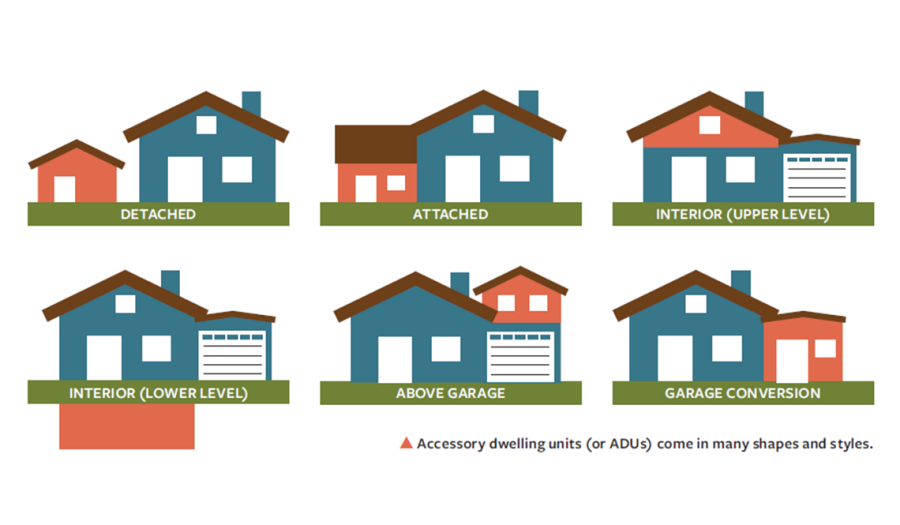
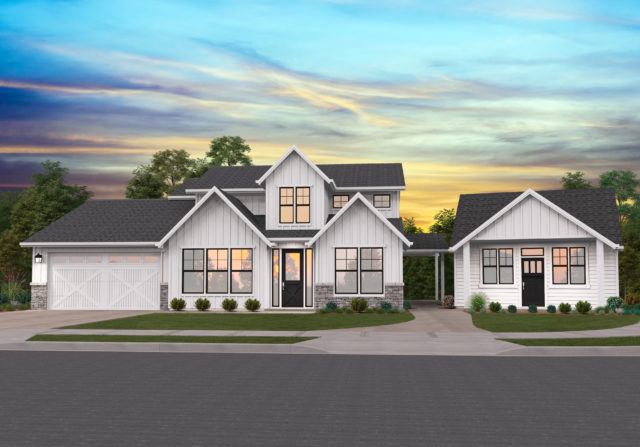
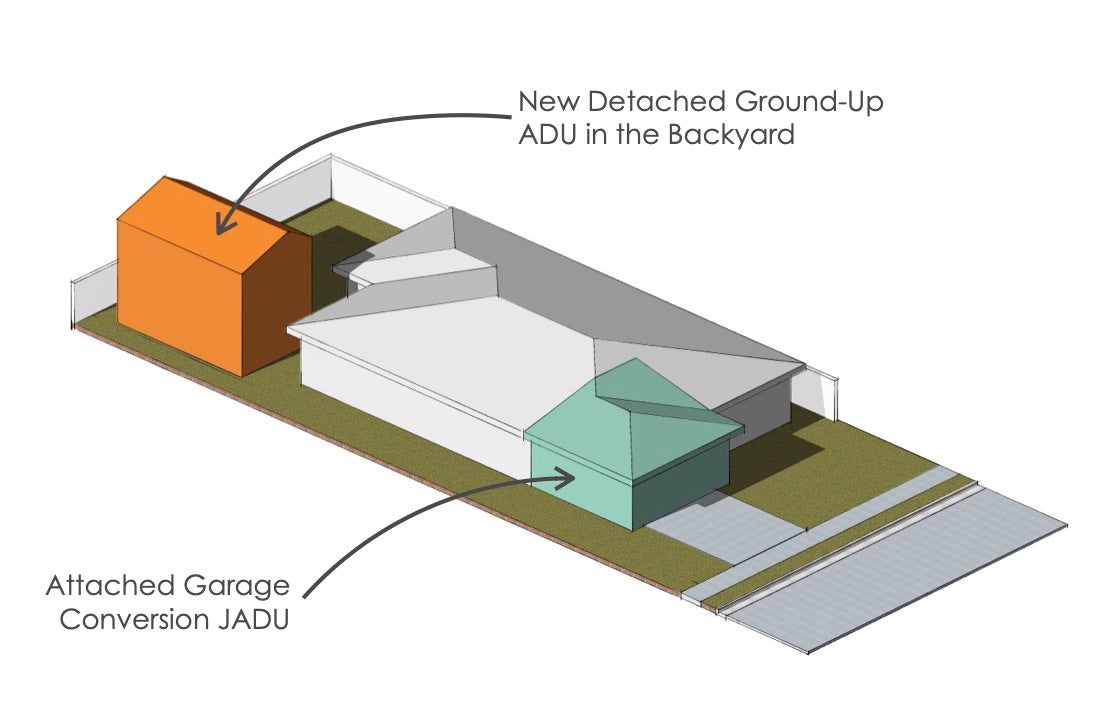
ADUs provide independent living quarters for one household on the same lot as the primary single-family dwelling. The ADU provides full facilities for sleeping, eating, cooking, and sanitation. The ADU may be detached, attached, or a converted structure located within the living areas of the primary dwelling unit on the lot.
- Detached: the ADU structure is detached from the primary dwelling unit.
- Attached: the ADU structure is attached to the primary dwelling unit.
- Converted: the ADU within the existing primary dwelling unit or the ADU was established through the conversion of an accessory structure, for example, a garage or pool house.
- Junior ADU: the ADU is within the existing walls of the single-family residence, and there is a size limit of 500 square-feet.
Knowing what type of ADU you want to build is important because there are different requirements and development standards for the various types of ADUs. Read more about the requirements on this webpage by clicking on the tabs above.
Junior ADUs
A Junior ADU may be created on a lot zoned for single-family residences with one primary dwelling. The requirements for Junior ADUs include the following:
- May be created within the walls of the proposed or existing single-family residence, including attached garages (as attached garages are considered within the walls of the existing single-family residence).
- Junior ADU is not allowed in accessory structures (the creation of a Junior ADU must be within the single-family residence).
- Junior ADU shall contain no more than 500 square-feet.
- Junior ADU created in the attached garage are not subject to the same parking protections as ADUs, and could be required by the local agency to provide replacement parking.
- Junior ADUs are limited to one (1) per residential lot with a single-family residence (lots with multiple detached single-family dwellings are not eligible to have Junior ADUs).
- They may share central systems, contain a basic kitchen utilizing small plug-in appliances, may share a bathroom with the primary dwelling.
- Create no additional stress on utility services or infrastructure because they simply re-purpose existing space within the residence and do not expand the dwelling’s occupancy.
Click on the ‘General Requirements’ tab above for a brief overview of development standards and parking requirements for Junior ADUs.
Click on the Accessory Dwelling Unit Handbook (at right) for more detailed information about height limits, setback requirements, parking requirements or exemptions, and other design regulations.
2024 State Law Update
Senate Bill (SB) 477 went into effect in March 2024, and made State ADU law easier to read and navigate. SB 477 relocated numerous Government Code sections pertaining to ADUs (e.g., 65852.2, 65852.22, 65852.26) into a new chapter, and key regulations are now divided into smaller sections by topic area. The changes to state law are only organizational (not substantive).
SB 477 added a new Chapter 13 to Division 1 of Title 7 of the Government Code. The new Chapter 13 is divided into four articles, and each article is further divided into various sections as follows:
- Article 1 – General Provisions. Now provided in Gov. Code sections 66310, 66311, 66312, and 66313.
- Article 2 – ADU Approvals. Now provided in Gov. Code sections 66314 through 66332.
- Article 3 – Junior ADUs. Now provided in Gov. Code sections 66333 through 66339.
- Article 4 – ADU Sales. Now provided in Gov. Code sections 66341 and 66342.
In addition, Senate Bill (SB) 1211 was signed into State law on September 19, 2024.
What are the benefits of ADUs?
- Affordability: ADUs are an affordable type of home to construct in California because they do not require paying for land, major new infrastructure, structured parking, or elevators.
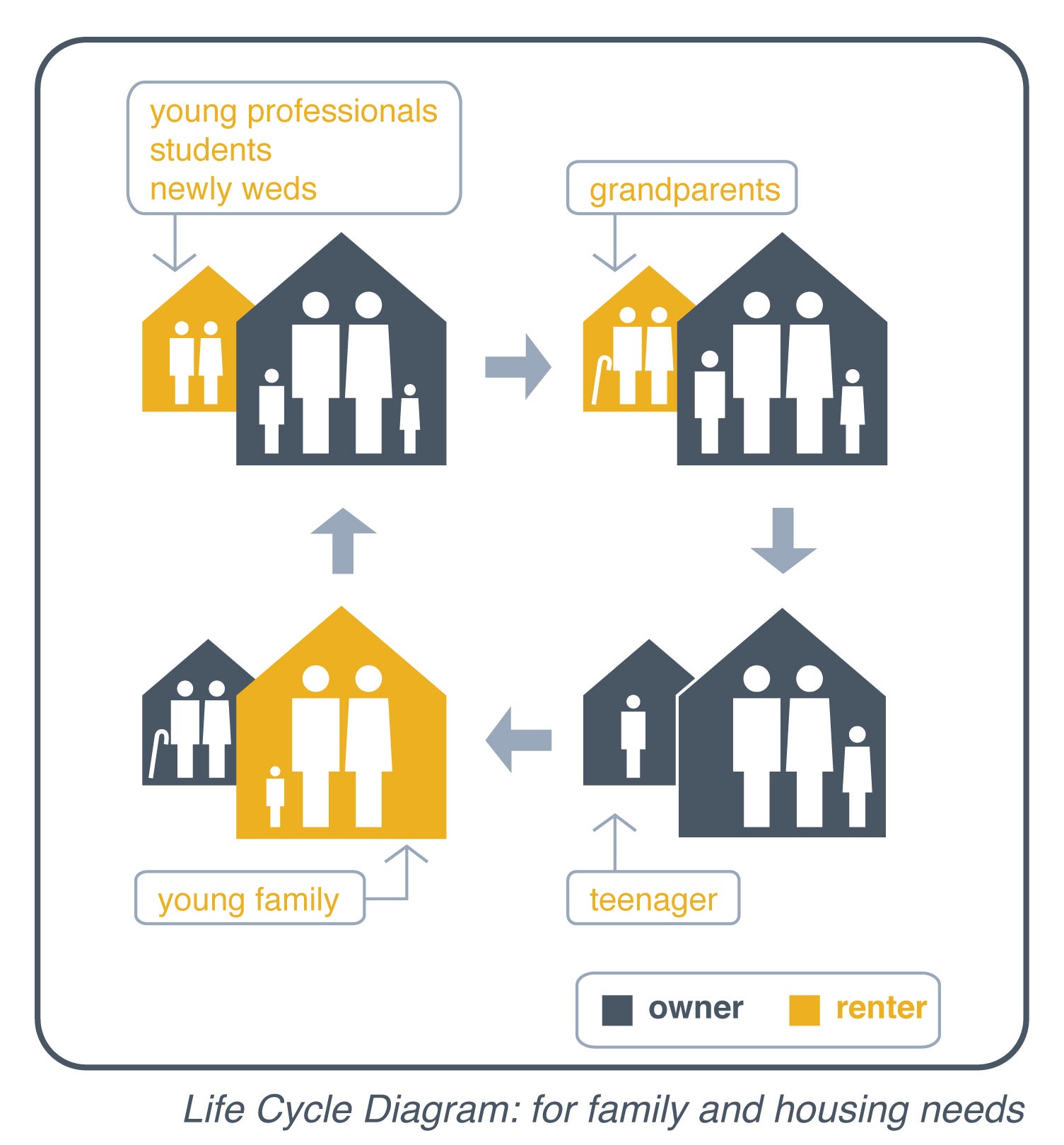
- Efficiency: ADUs can provide as much living space as many newly-built apartments and condominiums, and they’re suited well for couples, small families, friends, young people, and seniors.
- Cost-Effective: ADUs are built with cost-effective wood frame construction, which is significantly less costly than homes in new multifamily infill buildings. ADUs also use less energy and resources (electricity, water, etc.) than larger full-size homes.
- Income: ADUs can provide a source of income for homeowners. ADUs can also increase the property value.
- Flexibility: ADUs give homeowners the flexibility to share independent living areas with family members and others, allowing seniors to age in place as they require more care.
- Privacy: ADUs allow extended families to be near one another while maintaining privacy.
- Housing options: ADUs provide a method to build more housing quickly, within existing neighborhoods while preserving neighborhood character, and without increasing density. Building a new ADU usually takes a few months, as opposed to a new housing subdivision that could take two years or more.
Different Types of ADUs
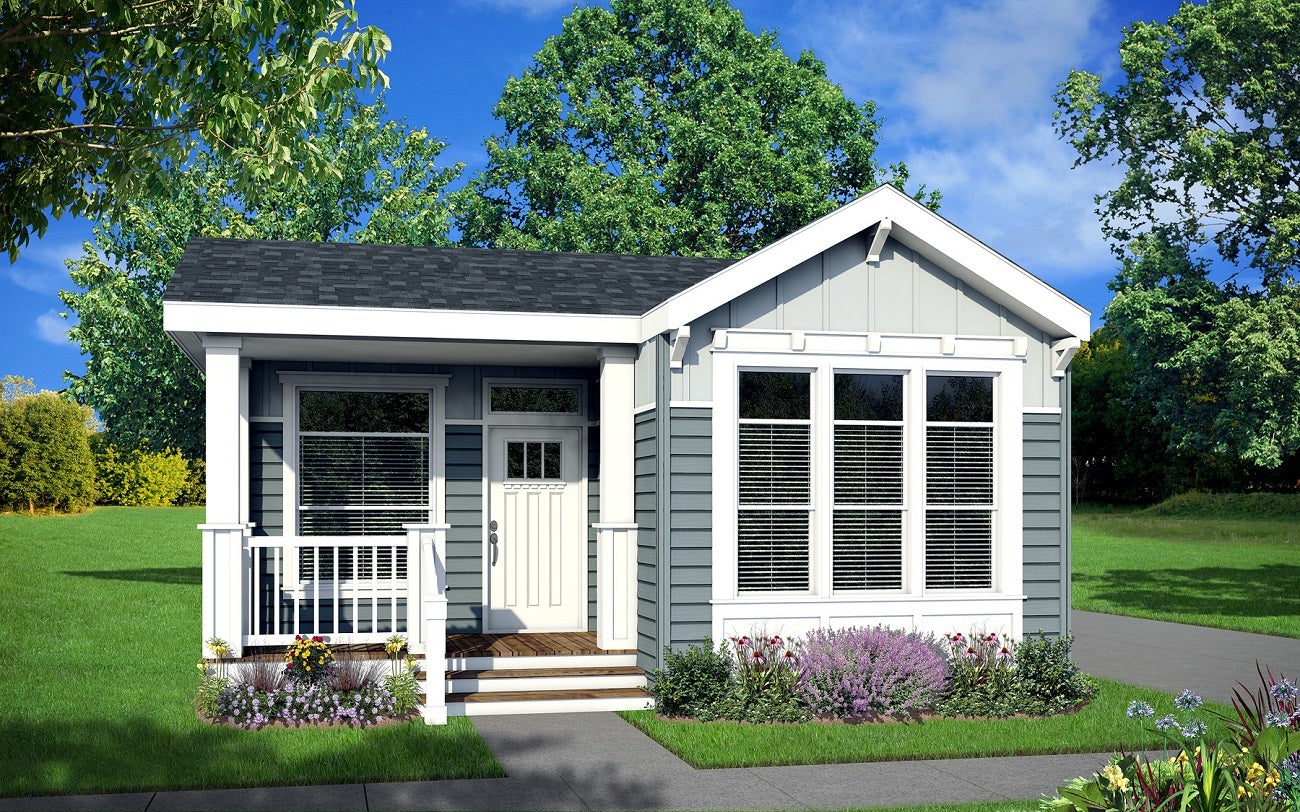
A) Detached ADUs
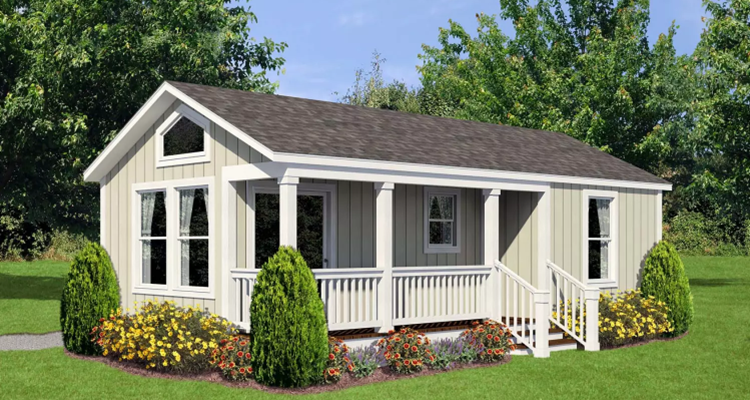
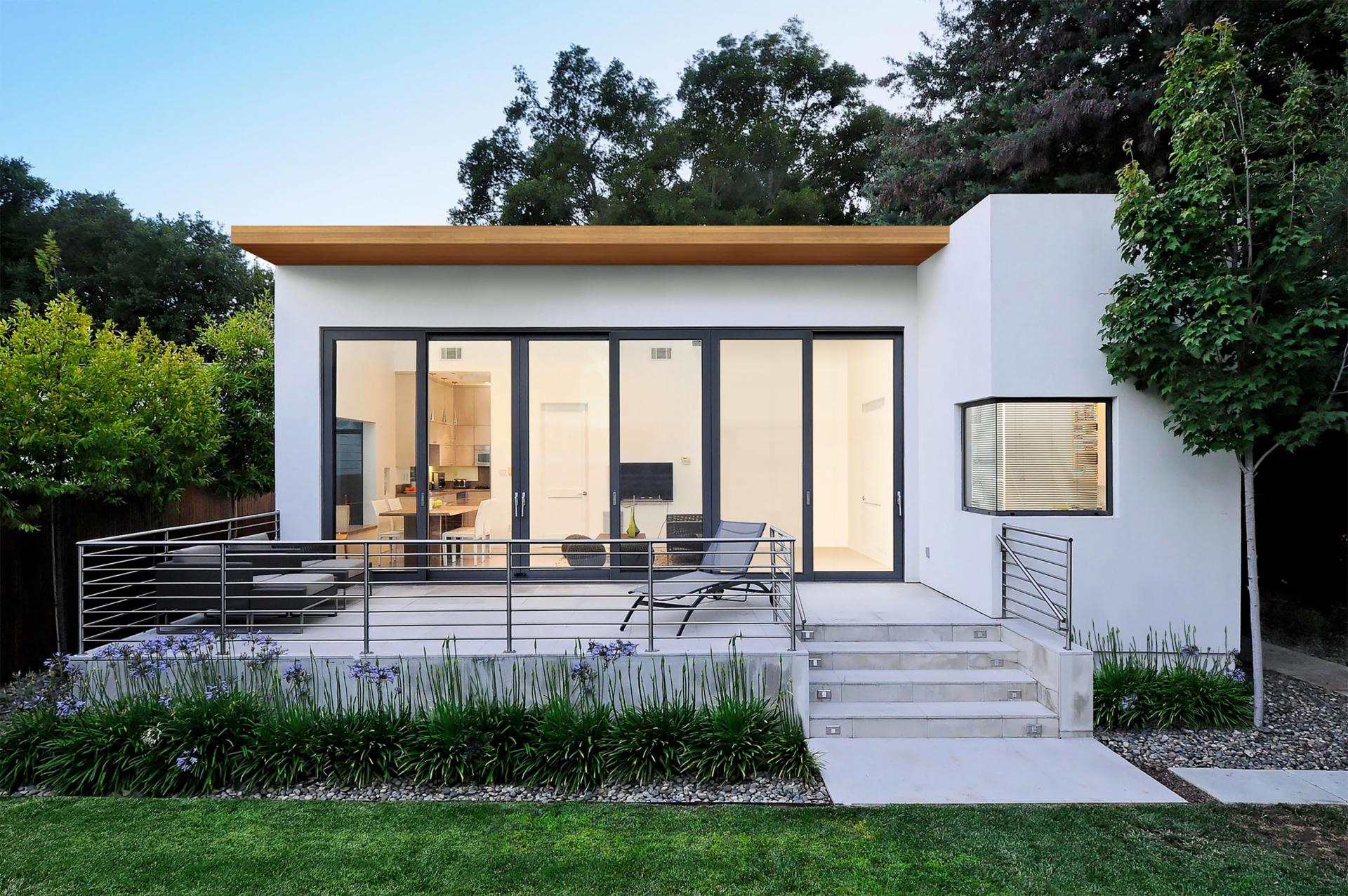
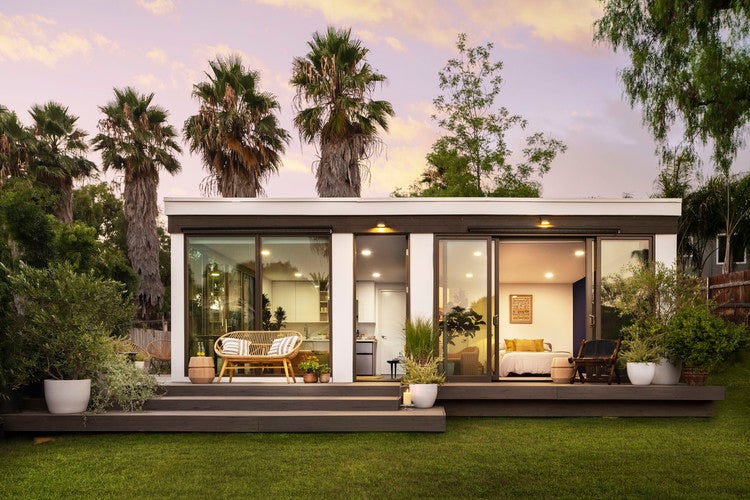
B) Attached ADUs
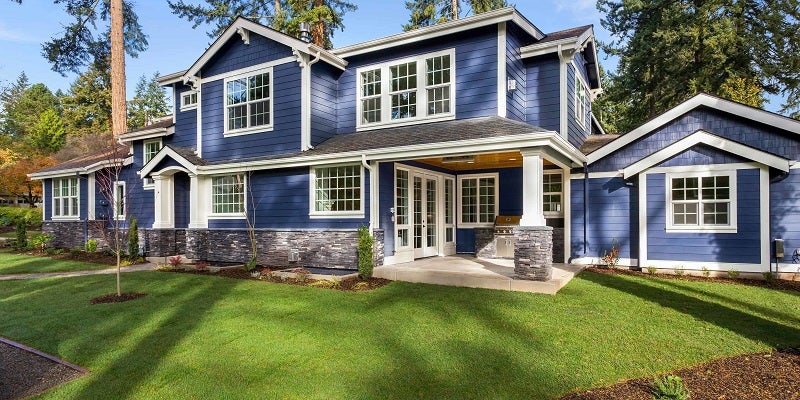
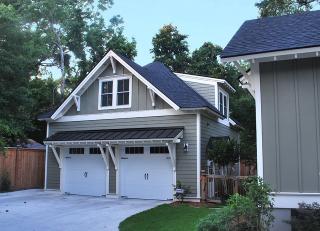
C) ADUs above a garage
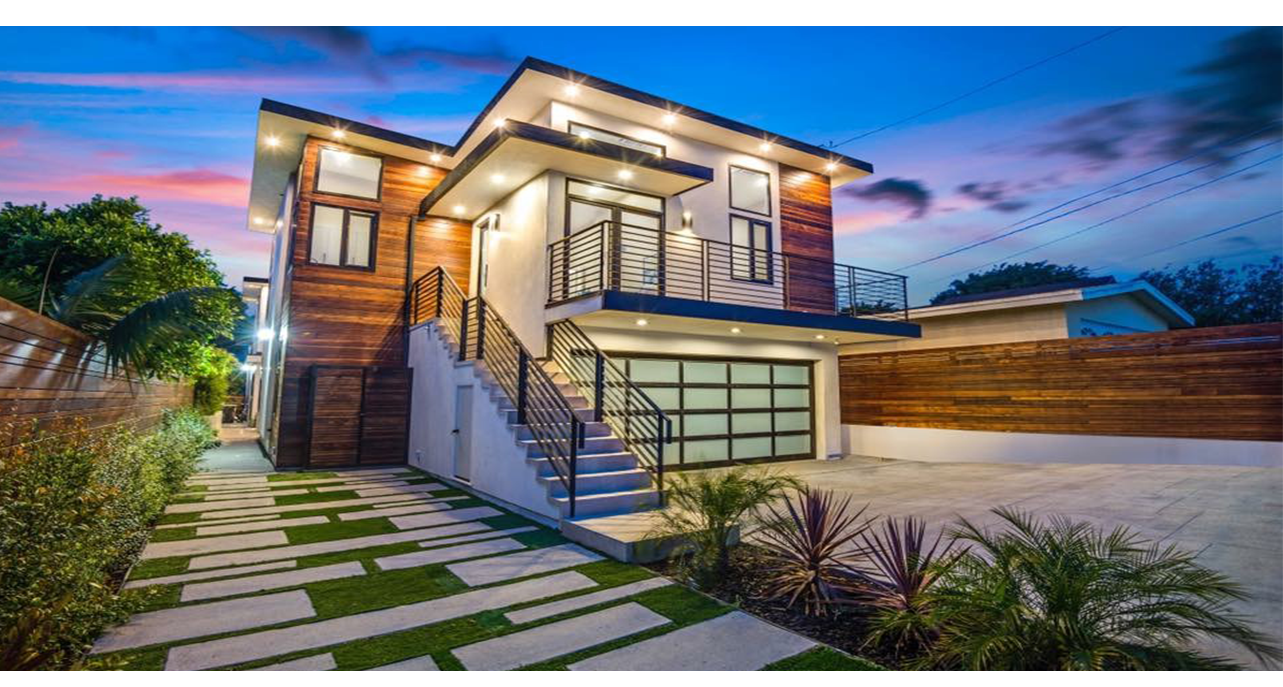
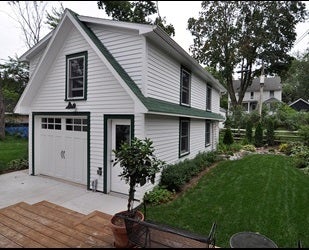
D) Junior ADU
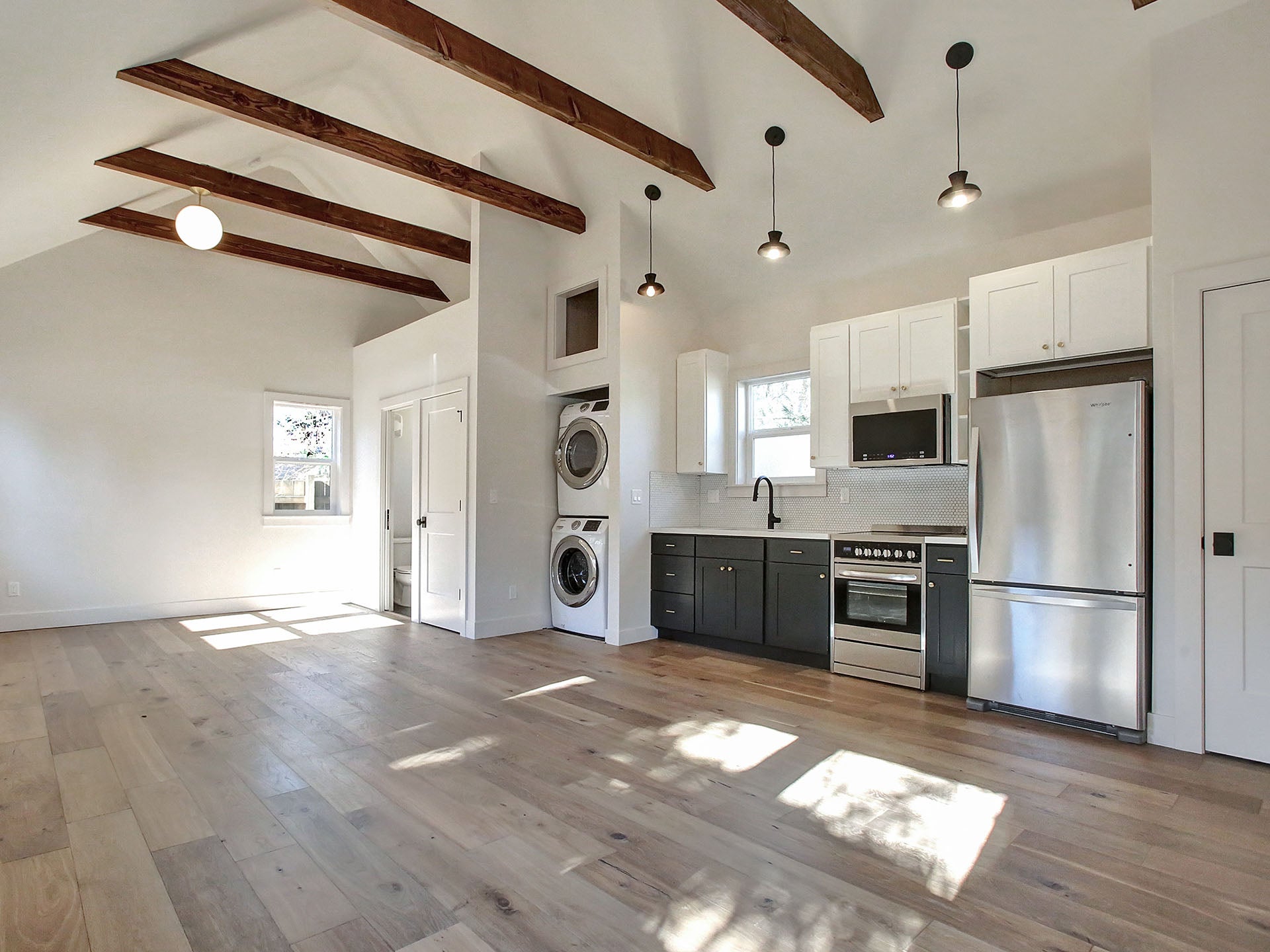
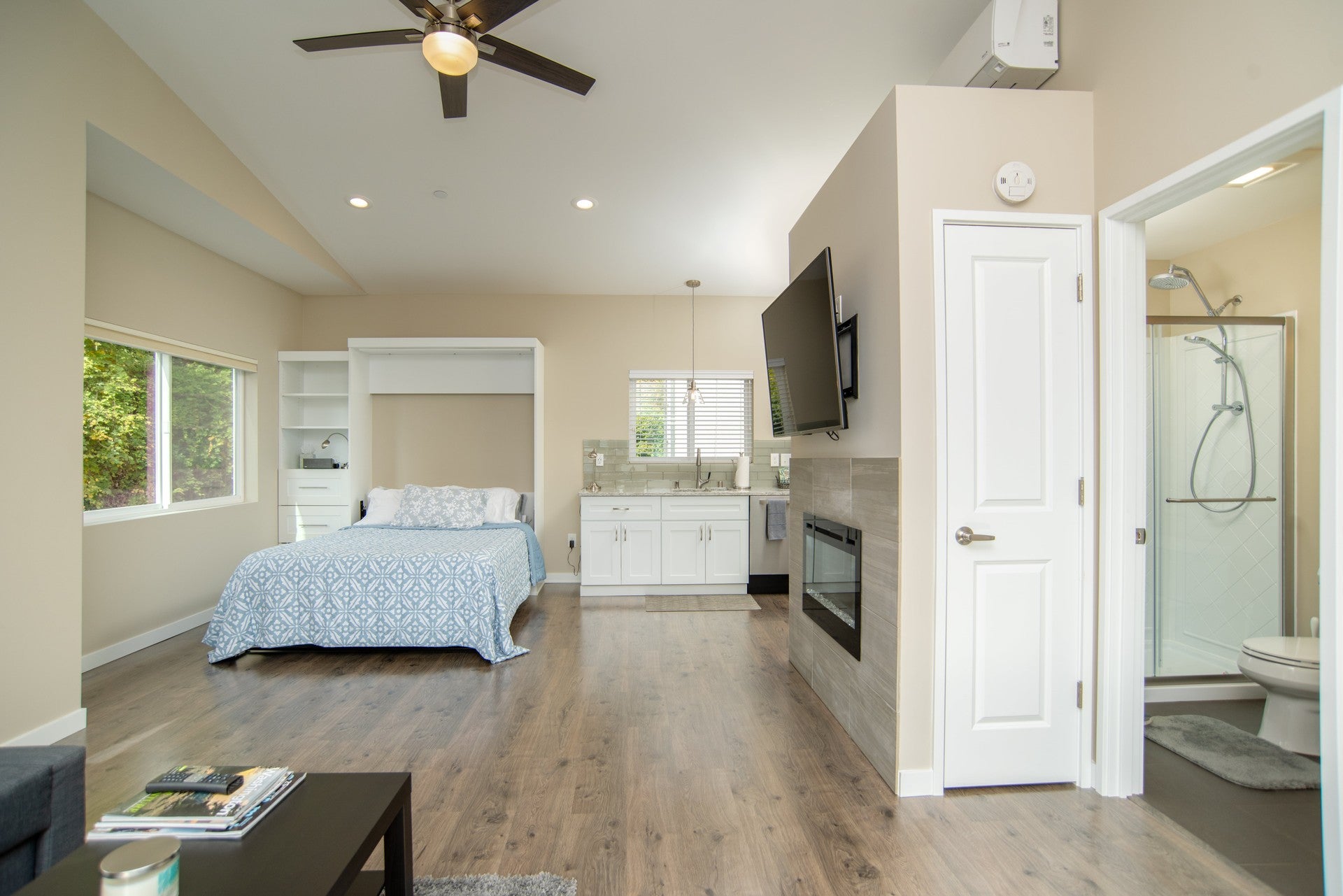
Home Owner’s Association:
Can a local Homeowners Association (HOA) prohibit the construction of an ADU or Junior ADU?
No. Assembly Bill 670 (2019) and AB 3182 (2020) amended Section 4751, 4740, and 4741 of the Civil Code to preclude common interest developments from prohibiting or unreasonably restricting the construction or use, including the renting or leasing of, an ADU on a lot zoned for single-family residential use. Covenants, conditions, and restrictions (CC&Rs) that either effectively prohibit or unreasonably restrict the construction or use of an ADU or Junior ADU on such lots are void and unenforceable or may be liable for actual damages and payment of a civil penalty. Applicants who encounter issues with creating ADUs or Junior ADUs within CC&Rs are encouraged to reach out to the California Department of Housing & Community Development for additional guidance.
Steps to building an ADU
Planning
- Homework and gather information (available on this webpage)
- Prepare a preliminary Site Plan to verify feasibility (click on Make A Site Plan tab above)
- Early consultation with city staff (Planning, Building, and Engineering staff at the One Stop Permit Center)
- Assemble your project team
- Architect or qualified consultant prepares initial design
- Review initial design with city staff
- Plan refinement
Design
- Construction plans prepared by architect or qualified consultant
- Comply with applicable provisions of California Building Code
- Comply with applicable provisions of California ADU law (see Accessory Dwelling Unit Handbook)
Permitting
- Application for a building permit
- Plan review by city staff
- Corrections or comments on plans
- Re-submit plans for further review, if required
- Pay any applicable fees
- Permit approval and issuance
Construction
- You or your contractor begins work
- Obtain necessary inspections as construction progresses
- Obtain final inspections and sign-off
Move-in
Standard Building Plans
Some cities and counties provide standard building plans online at no cost (sometimes referred to as “pre-approved” plans or “ADU Standard Plans”). However, applicants may still need to contact the architect or designer of a particular plan set for authorization to use that plan. The links below are provided for informational purposes only.
At this time, the Development Services Department is working with an architect to prepare ADU Standard Plans. We anticipate that final plans will be ready for public use in mid-2026. When these plans are available, applicants (or their design consultant) will still need to prepare a unique Site Plan for the subject property, and may need to prepare some additional technical information for submittal to the Building & Safety Division for compliance with the Calif. Building Code.
It is recommended that you hire a California-licensed architect or other qualified design professional to prepare your ADU plans prior to submittal to the City of Redlands Building & Safety Division. All construction plans must be reviewed and approved by staff through the Plan Check process.
A unique Site Plan must still be prepared for the subject property where the ADU is proposed to be located (to include structure setbacks, required yard areas, parking areas and vehicle access, required calculations, etc.). Other site-specific construction plans may also be necessary depending on the project site (e.g., foundation, structural, roof, etc.). The applicant/designer is responsible for ensuring ADU plan submittals meet all applicable design regulations of the California Building Code, California Fire Code, and State ADU law.
Note: When selecting an architectural style, please select the option that is the same or a similar design to the principal residence on the property (common styles in Redlands include Craftsman, Ranch, Spanish, and Mid-Century Modern, although there are also others). The ADU building materials and colors should be the same or similar to the principal residence.
City of Sacramento – ADU Plans
City of Los Angeles – ADU Plans
ADU California.org – Best Practices and links to other useful websites
For more information about how to apply for a building permit, Plan Check submittal requirements, Plan Check application fees, etc., please call the Building & Safety Division public counter at 909-798-7536 in the One Stop Permit Center (click here) between 8:00 AM and 4:30 PM.
How To Apply
Building permits are processed through the Building & Safety Division (referred to as a ‘Plan Check’). Application information is available from Building & Safety staff at the One Stop Permit Center.
Quick links:
Building Permit Application
Residential Plan Check
CALGreen Residential Checklist
For more information about how to apply for a building permit, Plan Check submittal requirements, Plan Check application fees, etc., please call the Building & Safety Division public counter at 909-798-7536 in the One Stop Permit Center (click here) between 8:00 AM and 4:30 PM.
Impact Fees
New developments often require the payment of Development Impact Fees (DIF) to offset the impacts of such development on public facilities and public services.
However, State law in 2019 updated the requirements for impact fees as they pertain to ADUs (see Assembly Bill 68). Calif. Gov. Code section 65852.2(f) states:
“(1) Fees charged for the construction of accessory dwelling units shall be determined in accordance with Chapter 5 (commencing with Section 66000) and Chapter 7 (commencing with Section 66012).
(2) An accessory dwelling unit shall not be considered by a local agency, special district, or water corporation to be a new residential use for purposes of calculating connection fees or capacity charges for utilities, including water and sewer service, unless the accessory dwelling unit was constructed with a new single-family dwelling.
(3) (A) A local agency, special district, or water corporation shall not impose any impact fee upon the development of an accessory dwelling unit less than 750 square feet. Any impact fees charged for an accessory dwelling unit of 750 square feet or more shall be charged proportionately in relation to the square footage of the primary dwelling unit.
(B) For purposes of this paragraph, “impact fee” has the same meaning as the term “fee” is defined in subdivision (b) of Section 66000, except that it also includes fees specified in Section 66477. “Impact fee” does not include any connection fee or capacity charge charged by a local agency, special district, or water corporation.
(4) For an accessory dwelling unit described in subparagraph (A) of paragraph (1) of subdivision (e), a local agency, special district, or water corporation shall not require the applicant to install a new or separate utility connection directly between the accessory dwelling unit and the utility or impose a related connection fee or capacity charge, unless the accessory dwelling unit was constructed with a new single-family dwelling, or upon separate conveyance of the accessory dwelling unit pursuant to paragraph (10) of subdivision (a).
(5) For an accessory dwelling unit that is not described in subparagraph (A) of paragraph (1) of subdivision (e), a local agency, special district, or water corporation may require a new or separate utility connection directly between the accessory dwelling unit and the utility. Consistent with Section 66013, the connection may be subject to a connection fee or capacity charge that shall be proportionate to the burden of the proposed accessory dwelling unit, based upon either its square feet or the number of its drainage fixture unit (DFU) values, as defined in the Uniform Plumbing Code adopted and published by the International Association of Plumbing and Mechanical Officials, upon the water or sewer system. This fee or charge shall not exceed the reasonable cost of providing this service.”
NOTE: All definitions and State regulations governing the creation of ADUs and Junior ADUs are now provided in Gov. Code section 66313.
Click on the following link to view the applicable Development Impact Fees (DIF) for ADUs:
https://www.cityofredlands.org/post/development-impact-fees
AMNESTY PROGRAM:
State law now includes a provision for the permitting of existing ADUs that were created without authorization. See Government Code section 66332:
“66332.
(a) Notwithstanding any other law, and except as otherwise provided in subdivision (b), a local agency shall not deny a permit for an unpermitted accessory dwelling unit or unpermitted junior accessory dwelling unit that was constructed before January 1, 2020, due to either of the following:
(1) The accessory dwelling unit or junior accessory dwelling unit is in violation of building standards pursuant to Article 1 (commencing with Section 17960) of Chapter 5 of Part 1.5 of Division 13 of the Health and Safety Code.
(2) The accessory dwelling unit or junior accessory dwelling unit does not comply with this article or Article 3 (commencing with Section 66333), as applicable, or any local ordinance regulating accessory dwelling units or junior accessory dwelling units.
(b) Notwithstanding subdivision (a), a local agency may deny a permit for an accessory dwelling unit or junior accessory dwelling unit subject to subdivision (a) if the local agency makes a finding that correcting the violation is necessary to comply with the standards specified in Section 17920.3 of the Health and Safety Code.
(c) This section shall not apply to a building that is deemed substandard pursuant to Section 17920.3 of the Health and Safety Code.
(d) A local agency shall inform the public about the provisions of this section through public information resources, including permit checklists and the local agency’s internet website, which shall include both of the following:
(1) A checklist of the conditions specified in Section 17920.3 of the Health and Safety Code that would deem a building substandard.
(2) Informing homeowners that, before submitting an application for a permit, the homeowner may obtain a confidential third-party code inspection from a licensed contractor to determine the unit’s existing condition or potential scope of building improvements before submitting an application for a permit.
(e) A homeowner applying for a permit for a previously unpermitted accessory dwelling unit or junior accessory dwelling unit constructed before January 1, 2020, shall not be required to pay impact fees or connection or capacity charges except when utility infrastructure is required to comply with Section 17920.3 of the Health and Safety Code and when the fee is authorized by subdivision (e) of Section 66324.
(f) Subject to subdivision (c), upon receiving an application to permit a previously unpermitted accessory dwelling unit or junior accessory dwelling unit constructed before January 1, 2020, an inspector from the local agency may inspect the unit for compliance with health and safety standards and provide recommendations to comply with health and safety standards necessary to obtain a permit. If the inspector finds noncompliance with health and safety standards, the local agency shall not penalize an applicant for having the unpermitted accessory dwelling unit or junior accessory dwelling unit and shall approve necessary permits to correct noncompliance with health and safety standards.”
Additional Information
The following links and documents are provided for informational purposes only.
Additional resources and guidance from the California HCD website:
https://www.hcd.ca.gov/policy-and-research/accessory-dwelling-units
Office of the State Fire Marshal – Information Bulletins


