Waste Reduction
Click here to go to the City’s Solid Waste page.
Waste reduction can take many forms. Adding more reusables into your day, saving food scraps to make a veggie stock, and buying refurbished electronics are all excellent ways to reduce waste.
You may have heard of the term “zero-waste,” which describes the goal to create absolutely no waste in your daily life. While zero waste is a great objective, it’s unrealistic. We encourage everyone to make waste-conscious choices where they can and practice the three R’s.
The City of Redlands Solid Waste Division works hard to make sure our waste is handled correctly and safely. The City operates its own landfill and solid waste collection operations. Commercial and residential trash is taken the City’s landfill for disposal. Recyclables are taken to Burrtec’s East Valley facility to be sorted and baled. Lastly, organic waste is consolidated and composted by a local landscaping company. Learn more about the City’s Solid Waste services by clicking here.
Solid Waste and the Climate Action Plan
The Climate Action Plan (CAP) has multiple measures to address our trash problem and the associated greenhouse gasses (GHGs).
In a nutshell, the CAP sets goals to increase organic waste recycling, reduce single-use plastics, and reach a 75% landfill diversion rate. By achieving these goals, we will reduce the generation of GHGs, prevent littler and pollution, save valuable landfill space, and work towards a more circular economy.
Don’t worry, your kitchen trash can isn’t emitting methane directly into your home. Waste generates GHGs in multiple ways:
Decomposing organic waste in landfills generates methane.
When organic materials, like yard clippings and food scraps, are put into the landfill, they begin to decompose anaerobically, or without oxygen (check out this page on the carbon cycle for a refresher on decomposition).
Without oxygen, the chemical reaction that causes decomposition generates methane gas. Methane is a GHG with a warming potential 84 times as strong as Carbon Dioxide. Carbon Dioxide is the natural byproduct of the decomposition cycle. Remember, not all CO2 is bad, just when we have too much of it.
The City of Redlands makes it easy to keep organics out of the landfill. Simply place your food scraps and yard waste in the green container. Learn more here.
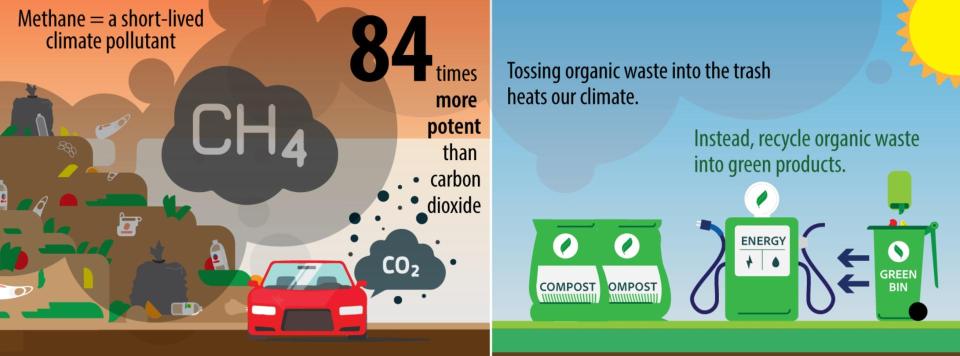
Transporting and processing our waste relies on fossil fuels.
All steps of the waste system rely on fossil fuels. This includes the trucks we use to haul our waste, the loaders that are used to bury our trash, and the machinery used to process recyclables. By wasting less, we use less of the fossil fuels needed in this process.
Goods and products generate GHGs when they are manufactured, shipped, and handled.
When we throw something away, we are also throwing away all of the resources that were used to make that item. For example, plastic bottles are manufactured using crude oil and fossil fuels power the process. Relying less on single-use items helps conserve valuable resources and limits GHG emissions. Here is further information on the energy and resources needed to produce a plastic water bottle.
When materials are recycled or otherwise disposed of properly, they are diverted from the landfill. The diversion rate tells us what percentage of our waste is currently being diverted from the landfill.
The CAP has two separate diversion goals:
- 75% of all organic waste is diverted from the landfill and compost or mulched
- 75% of ALL waste is diverted from the landfill and properly disposed of through recycling, hazardous waste disposal, organics recycling, or reuse.
Single-use plastics are items made from fossil fuels that are designed to be thrown away. These items can easily be avoided by reusable alternatives. Click here to read our post on single-use plastic alternatives. Instead of coffee cups and water bottles, we should be saving our plastics for when we really need it, such as in medicine and scientific research. Avoiding single-use also has all the waste reduction benefits listed above.
Single-use plastics are also the most littered item. Cigarette butts (yep, that’s plastic) and food packaging are the most prevalent type of litter found in California’s water ways. The 2018 California Ocean Litter Strategy shared the following data on litter:
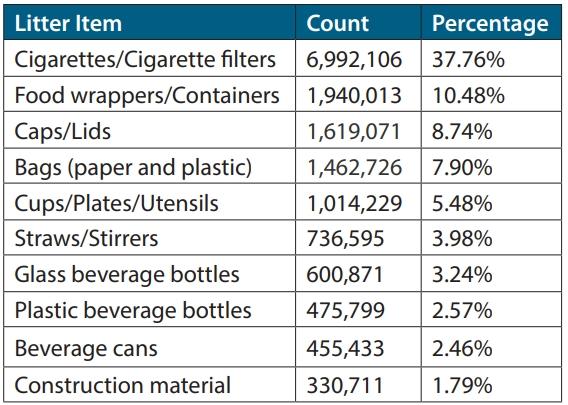
California Ocean Protection Council and National Oceanic and Atmospheric Administration Marine Debris Program. (2018). California Ocean Litter Prevention Strategy: Addressing Marine Debris from Source to Sea.
Sticking to reusables also shows manufactures that consumers don’t want single-use plastics. Less demand = less manufacturing = less single-use plastics!
Lastly, these materials contribute to microplastics…
Check out our page on the Circular Economy and the 6 R’s here.
Share this page


